Sequences Are Trajectories
Dive into Deep Learning · §15.7
Sequences are trajectories
text generation is a degenerate MDP · one factorization identity · what collapses, what survives · the contract the Language Models part inherits
The Dictionary
| language modeling | reinforcement learning |
|---|---|
| prompt x | start state s_0 \sim \mu_0 |
| token y_t | action a_t |
| prefix (x, y_{<t}) | state s_t |
| response y | trajectory \tau |
| EOS | terminal state |
| next-token softmax | the policy \pi_\theta |
generate |
rollout |
Transitions are concatenation: deterministic, known, probability one. All randomness is the policy’s; the reward is terminal.
One Identity
\nabla_\theta \log \pi_\theta(y \mid x) = \sum_{t=1}^{T} \nabla_\theta \log \pi_\theta(y_t \mid x, y_{<t})
- chain rule, no transition factors to drop: three-line proof
- terminal reward \Rightarrow one response-level weight r(x, y) - b(x) on every token’s score (not the prefix-dependent A(s_t, a_t))
- one action per episode: the contextual bandit of :numref:
sec_qlearning, until multi-turn closes the loop
What Collapses, What Survives
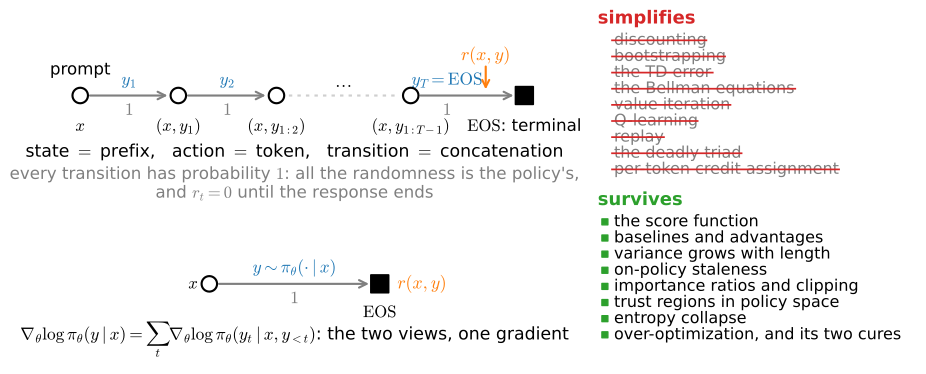
Everything that leaned on the kernel or on intermediate reward collapsed; the policy-optimization spine survived whole.
The Group Is the Baseline
Sample K responses per prompt, standardize within the group, one step on the log-probs. Same-group centering is biased: its expectation is (K-1)/K of the gradient (leave-one-out is exact). Prediction: at K = 1 the shrinkage reaches zero and the update vanishes identically.
K =  1: success of a sampled response 0.062
K =  2: success of a sampled response 0.500
K =  4: success of a sampled response 0.500
K =  8: success of a sampled response 0.500
K = 32: success of a sampled response 0.500
0.062 is the reference, untouched: self-inclusion bias at its maximum, not “no relative information”. “The group mean replaced the critic”, as a measurement.
The Loophole
A sloppy grader greps for the answer; a hedge that lists every number passes everything. :eqref:eq_kl_optimum prices it: exploit pays iff $< $ reward gap / reference log-odds = 1/4.
beta = 0.0: sloppy 1.00, gold 0.50, hedge 0.50
beta = 0.1: sloppy 0.99, gold 0.50, hedge 0.49
beta = 0.2: sloppy 0.60, gold 0.48, hedge 0.12
beta = 0.3: sloppy 0.42, gold 0.39, hedge 0.04
beta = 0.5: sloppy 0.25, gold 0.24, hedge 0.01
Hacked at \beta = 0; stops paying past 0.2; every row lands close to the tilted optimum. \beta is an exchange rate, not a safety valve.
GRPO, Assembled from Owned Parts
- group-standardized advantage: :numref:
sec_baselines’s :eqref:eq_pg_normalized, group mean as baseline (biased by self-inclusion; LOO is the exact variant), no value network - a few epochs per group: token-level clipped ratios :eqref:
eq_ppo_clip - \beta\, D_{\textrm{KL}} to the frozen reference as a separate estimator: :eqref:
eq_kl_objective - both KLs at once: clip against the previous iterate, penalty against the frozen reference
- the toy simplifies: one step per group (nothing clipped), KL folded into the reward, one-token responses
Read :eqref:eq_kl_optimum backwards and preferences fit the policy directly: DPO :cite:Rafailov.Sharma.Mitchell.ea.2023.
The Contract
Reward is learned (Bradley-Terry, :numref:sec_regularized) or checked (a verifier: RLVR :cite:DeepSeekAI.2025). Either way it is an estimate, and an optimizer finds an estimate’s errors: \hat{Q} in :numref:sec_offline, r_\phi in :numref:sec_regularized, the grader here.
:numref:tab_rl_notation_contract: x, y, \tau, \mu_0, \pi_{\textrm{ref}}, \hat{G}_t, A, K, \rho_t, \epsilon, \beta, \delta_t, w: inherited verbatim by the Language Models part.
Where To Go Next
- search: MCTS is a policy-improvement operator, distilled back into the network; AlphaZero \to MuZero \to world models; the same pattern as test-time reasoning
- continuous control: same objectives, gains from normalization and scale
- omitted with pointers: multi-agent, distributional, meta, hierarchical, POMDPs
- next read: the RLHF book :cite:
Lambert.2026; you own every estimator in it
Recap
- prompt = start state, token = action, prefix = state, response = trajectory; transitions are concatenation
- one gradient, two views; terminal reward puts one response-level weight r - b(x) on every token
- K = 1’s update is identically zero (self-inclusion bias at its maximum), measured; the hedge gets hacked, measured; $= $ gap / log-odds prices the exploit
- what survives is the policy-optimization spine, and the Language Models part inherits it verbatim