@d2l.add_to_class(d2l.Batch)
def backward_scan(self, x, factor):
    """y_t = x_t + factor * y_{t+1}, restarted at every episode boundary."""
    y = np.zeros_like(x)
    for ep in self.episodes():
        running = 0.0
        for t in reversed(range(ep.start, ep.stop)):
            running = x[t] + factor * running
            y[t] = running
    return y

@d2l.add_to_class(d2l.Batch)
def reward_to_go(self, gamma):
    """G_t: the discounted return of the rest of its episode, by one scan."""
return self.backward_scan(self.rew, gamma)Baselines, Advantages and Variance Reduction
Dive into Deep Learning · §14.6
Baselines, advantages and variance reduction
one zero-mean identity · reward-to-go, baselines, control variates · centering is a baseline, dividing by \sigma is a step size · measured against the exact gradient
One Zero-Mean Identity
\sum_a \pi_\theta(a \mid s)\, \nabla_\theta \log \pi_\theta(a \mid s) = \nabla_\theta \sum_a \pi_\theta(a \mid s) = \nabla_\theta 1 = 0
Condition on the prefix: anything already determined at s_t has a mean-zero product with the score,
E\big[ c\ \nabla_\theta \log \pi_\theta(a_t \mid s_t) \big] = 0.
Multiply a score by such a c, or subtract it from the weight, and the average never moves. Everything in this section is this lemma.
Reward-to-Go: One Scan
Past rewards pair with the score at t to zero mean. Drop them:
\hat u = \frac1n \sum_i \sum_t \hat G^i_t\, \nabla_\theta \log \pi_\theta(a^i_t \mid s^i_t), \qquad \hat G_t = \sum_{t'\ge t} \gamma^{t'-t} r_{t'}.
GAE will be this same scan, run on TD errors with factor \gamma\lambda.
A Baseline Is a Control Variate
To estimate E[X]: subtract anything whose mean you know,
X_c = X - c\,(Y - E[Y]), \qquad c^* = \frac{\mathrm{Cov}(X,Y)}{\mathrm{Var}(Y)} \ \Rightarrow\ \mathrm{Var} = (1-\mathrm{corr}^2)\,\mathrm{Var}(X).
At \mathrm{corr} = 0.9 the variance falls by a factor of about five.
Here: X = \hat G_t \nabla_\theta \log \pi_\theta(a_t \mid s_t), \ Y = \nabla_\theta \log \pi_\theta(a_t \mid s_t), \ E[Y] = 0 by the lemma. Choosing b(s_t) is choosing c; the optimum is c^*, state by state.
One Picture
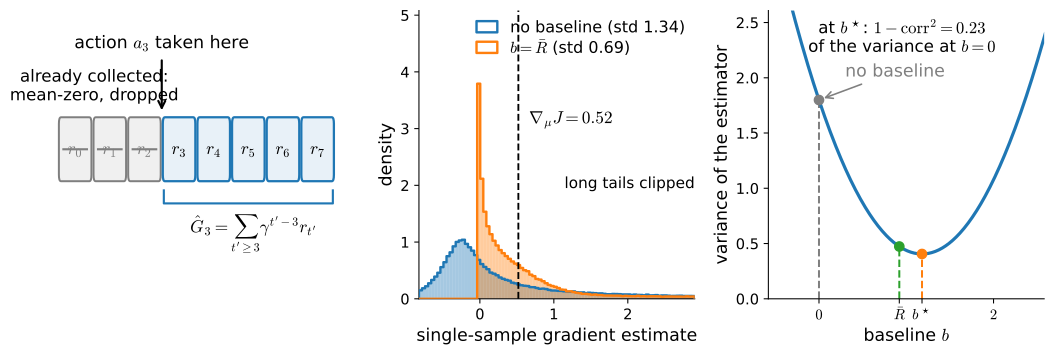
Drop the past; subtract b = E[R] and the std halves (1.34 \to 0.69); the parabola’s optimum b^\star leaves 1 - \mathrm{corr}^2 = 0.23 of the variance.
The Advantage, and a Learned Baseline
The best b(s) is the value function: then the weight is a sampled advantage (:numref:sec_valueiter defined it).
\hat V(s_t) \leftarrow \hat V(s_t) + \alpha_V\,(\hat G_t - \hat V(s_t)), \qquad \textrm{weight} = \hat G_t - \hat V(s_t) \approx A^{\pi_\theta}.
Monte Carlo regression today; bootstrapped targets are actor-critic (next chapter).
Estimator Hygiene
Leave-one-out: b_i = \frac{1}{n-1}\sum_{j \neq i} R(\tau_j), independent of trajectory i: exactly unbiased. It is \frac{n}{n-1} \times centering, and it is RLOO.
What do you divide the summed loss by?
episode lengths [ 8 20  8 11], successes 3
    episodes: |grad| = 0.868, cos to episodes = 1.000
  own length: |grad| = 0.082, cos to episodes = 0.937
 total steps: |grad| = 0.074, cos to episodes = 1.000
  a constant: |grad| = 0.109, cos to episodes = 1.000
Three pure rescalings, one changed direction: the Dr. GRPO / token-loss debate on a four-episode batch.
Normalized Returns Became GRPO
A_j = \frac{r_j - \mu}{\sigma + 10^{-8}}
- prompt \leftrightarrow start state; group of K responses \leftrightarrow batch of trajectories
- group mean = a free per-prompt baseline (no value network!)
- dividing by \sigma: a per-prompt step-size rescaling, not a baseline (Dr. GRPO’s objection)
Five Estimators at a Frozen Theta
Same frozen policy as the last section’s yardstick; the exact gradient grades every claim.
        return: cos(mean, exact) = 0.98, relative variance =   11.1
  reward-to-go: cos(mean, exact) = 0.97, relative variance =   10.6
      centered: cos(mean, exact) = 0.98, relative variance =    7.1
    normalized: cos(mean, exact) = 0.97, relative variance =    6.9
exact baseline: cos(mean, exact) = 0.98, relative variance =    5.3
Baselines move nothing (cosines agree). Centering cuts variance by a third; the exact state baseline nearly halves it; \div\,\sigma adds nothing; reward-to-go buys a few percent, because terminal-only reward leaves causality nothing to drop.
The Race, and Both Ledgers
Same \alpha (plain SGD, on purpose), same batches, twenty seeds; five arms differing in one line.
          return: updates to 90%: median  60.0, fastest  26, slowest  92
                  mean |step| over the first 40 updates: 0.20
    reward-to-go: updates to 90%: median  40.0, fastest  22, slowest  95
                  mean |step| over the first 40 updates: 0.38
        centered: updates to 90%: median  58.0, fastest  43, slowest 108
                  mean |step| over the first 40 updates: 0.15
      normalized: updates to 90%: median  30.0, fastest   8, slowest  72
                  mean |step| over the first 40 updates: 0.76
learned baseline: updates to 90%: median  40.5, fastest  22, slowest  84
mean |step| over the first 40 updates: 0.32- normalized wins the race, but its steps are about 5\times centered’s and 2\times reward-to-go’s
- subtracting \mu: a baseline. Dividing by \sigma + 10^{-8}: a per-batch step size, not a baseline.
- at fixed \alpha, the race tracks step size at least as much as variance
How To Read RL Curves
- every band is wide: slowest seed > 2\times the fastest, same variant, only the seed changed
- one training curve is an anecdote; a lucky-vs-unlucky pairing flips the conclusion
- twenty seeds pin the ordering, not the digits: quote ranges and ratios
- several seeds, matched hyper-parameters, medians, spread :cite:
Henderson.Islam.Bachman.ea.2018,Agarwal.Schwarzer.Castro.ea.2021,Engstrom.Ilyas.Santurkar.ea.2020
Recap
- One lemma: the score has zero conditional mean; anything determined at s_t can weight or offset it, bias-free.
- Reward-to-go, baselines, the optimal c^*, the learned \hat V: four uses of the identity.
- A baseline is a control variate; (1 - \mathrm{corr}^2) says what it buys.
- Centering is a baseline; \div\,\sigma is a step size; leave-one-out is exact; the loss divisor is a fourth estimator choice. GRPO is this section at scale.
- Entropy fell from \ln 4 to about 0.8 nats unmanaged: :numref:
sec_ppotakes over from here.