from d2l import torch as d2l
import torch
from torch import nn

batch_size = 64
train_iter, test_iter, vocab = d2l.load_data_imdb(batch_size)19.2 Sentiment Analysis: Using Recurrent Neural Networks
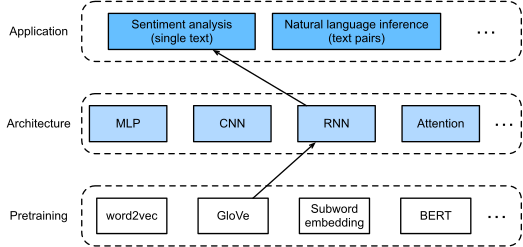
Like word similarity and analogy tasks, we can also apply pretrained word vectors to sentiment analysis. Since the IMDb review dataset in Section 19.1 is not very big, using text representations that were pretrained on large-scale corpora may reduce overfitting of the model. As a specific example illustrated in Figure 19.2.1, we will represent each token using the pretrained GloVe model, and feed these token representations into a multilayer bidirectional RNN to obtain the text sequence representation, which will be transformed into sentiment analysis outputs (Maas et al. 2011). For the same downstream application, we will consider a different architectural choice later.
from d2l import tensorflow as d2l
import tensorflow as tf
import keras
import numpy as np

batch_size = 64
train_iter, test_iter, vocab = d2l.load_data_imdb(batch_size)
# d2l.load_array uses shuffle(buffer_size=1000), which is too small for
# the IMDb training set (25000 examples ordered as 12500 positives then
# 12500 negatives). Reshuffle the full dataset so each epoch sees a
# properly mixed class distribution, matching the PyTorch/JAX behavior.
train_iter = (train_iter.unbatch()
              .shuffle(25000, reshuffle_each_iteration=True)
              .batch(batch_size))
from d2l import jax as d2l
import jax
from jax import numpy as jnp
from flax import nnx
import optax
import numpy as np
batch_size = 128
train_iter, test_iter, vocab = d2l.load_data_imdb(batch_size)from d2l import mxnet as d2l
from mxnet import gluon, init, np, npx
from mxnet.gluon import nn, rnn
npx.set_np()
batch_size = 64
train_iter, test_iter, vocab = d2l.load_data_imdb(batch_size)19.2.1 Representing Single Text with RNNs
In text classification tasks, such as sentiment analysis, a varying-length text sequence will be transformed into fixed-length categories. In the following BiRNN class, while each token of a text sequence gets its individual pretrained GloVe representation via the embedding layer (self.embedding), the entire sequence is encoded by a bidirectional RNN (self.encoder). More concretely, the hidden states (at the last layer) of the bidirectional LSTM at both the initial and final time steps are concatenated as the representation of the text sequence. This single text representation is then transformed into output categories by a fully connected layer (self.decoder) with two outputs (“positive” and “negative”).
class BiRNN(nn.Module):
    def __init__(self, vocab_size, embed_size, num_hiddens,
                 num_layers, **kwargs):
        super(BiRNN, self).__init__(**kwargs)
        self.embedding = nn.Embedding(vocab_size, embed_size)
        # Set `bidirectional` to True to get a bidirectional RNN
        self.encoder = nn.LSTM(embed_size, num_hiddens, num_layers=num_layers,
                                bidirectional=True)
        self.decoder = nn.Linear(4 * num_hiddens, 2)

    def forward(self, inputs):
        # The shape of `inputs` is (batch size, no. of time steps). Because
        # LSTM requires its input's first dimension to be the temporal
        # dimension, the input is transposed before obtaining token
        # representations. The output shape is (no. of time steps, batch size,
        # word vector dimension)
        embeddings = self.embedding(inputs.T)
        self.encoder.flatten_parameters()
        # Returns hidden states of the last hidden layer at different time
        # steps. The shape of `outputs` is (no. of time steps, batch size,
        # 2 * no. of hidden units)
        outputs, _ = self.encoder(embeddings)
        # Concatenate the hidden states at the initial and final time steps as
        # the input of the fully connected layer. Its shape is (batch size,
        # 4 * no. of hidden units)
        encoding = torch.cat((outputs[0], outputs[-1]), dim=1)
        outs = self.decoder(encoding)
        return outs
class BiRNN(d2l.Classifier):
def __init__(self, vocab_size, embed_size, num_hiddens, num_layers,
**kwargs):
super().__init__(**kwargs)
self.embedding = keras.layers.Embedding(vocab_size, embed_size)
# Stack bidirectional LSTM layers; all layers return the full
# sequence so we can concatenate the initial- and final-step
# hidden states downstream.
self.encoder = keras.Sequential([
keras.layers.Bidirectional(
keras.layers.LSTM(num_hiddens, return_sequences=True))
for _ in range(num_layers - 1)
] + [
keras.layers.Bidirectional(
keras.layers.LSTM(num_hiddens, return_sequences=True))
])
self.decoder = keras.layers.Dense(2)
def call(self, inputs, training=False):
# inputs shape: (batch_size, num_steps)
embeddings = self.embedding(inputs)
# outputs shape: (batch_size, num_steps, 2 * num_hiddens)
outputs = self.encoder(embeddings, training=training)
# Concatenate hidden states at initial and final time steps
# Shape: (batch_size, 4 * num_hiddens)
encoding = tf.concat([outputs[:, 0, :], outputs[:, -1, :]], axis=1)
outs = self.decoder(encoding)
return outsclass BiRNN(nnx.Module):
def __init__(self, vocab_size, embed_size, num_hiddens, num_layers,
rngs=None):
rngs = nnx.Rngs(params=0, carry=1) if rngs is None else rngs
self.embedding = nnx.Embed(vocab_size, embed_size, rngs=rngs)
self.forward_rnns = nnx.List([])
self.backward_rnns = nnx.List([])
for i in range(num_layers):
num_inputs = embed_size if i == 0 else 2 * num_hiddens
self.forward_rnns.append(nnx.RNN(
nnx.LSTMCell(num_inputs, num_hiddens, rngs=rngs), rngs=rngs))
self.backward_rnns.append(nnx.RNN(
nnx.LSTMCell(num_inputs, num_hiddens, rngs=rngs),
reverse=True, keep_order=True, rngs=rngs))
self.decoder = nnx.Linear(4 * num_hiddens, 2, rngs=rngs)
def __call__(self, inputs):
# The shape of `inputs` is (batch size, no. of time steps)
embeddings = self.embedding(inputs)
outputs = embeddings
for forward_rnn, backward_rnn in zip(
self.forward_rnns, self.backward_rnns):
outputs = jnp.concatenate(
[forward_rnn(outputs), backward_rnn(outputs)], axis=-1)
# Each endpoint contains both directions, so concatenating the first
# and last time steps produces 4 * num_hiddens features.
encoding = jnp.concatenate([outputs[:, 0, :], outputs[:, -1, :]],
axis=1)
outs = self.decoder(encoding)
return outsclass BiRNN(nn.Block):
def __init__(self, vocab_size, embed_size, num_hiddens,
num_layers):
super().__init__()
self.embedding = nn.Embedding(vocab_size, embed_size)
# Set `bidirectional` to True to get a bidirectional RNN
self.encoder = rnn.LSTM(num_hiddens, num_layers=num_layers,
bidirectional=True, input_size=embed_size)
self.decoder = nn.Dense(2)
def forward(self, inputs):
# The shape of `inputs` is (batch size, no. of time steps). Because
# LSTM requires its input's first dimension to be the temporal
# dimension, the input is transposed before obtaining token
# representations. The output shape is (no. of time steps, batch size,
# word vector dimension)
embeddings = self.embedding(inputs.T)
# Returns hidden states of the last hidden layer at different time
# steps. The shape of `outputs` is (no. of time steps, batch size,
# 2 * no. of hidden units)
outputs = self.encoder(embeddings)
# Concatenate the hidden states at the initial and final time steps as
# the input of the fully connected layer. Its shape is (batch size,
# 4 * no. of hidden units)
encoding = np.concatenate((outputs[0], outputs[-1]), axis=1)
outs = self.decoder(encoding)
return outsLet’s construct a bidirectional RNN with two hidden layers to represent single text for sentiment analysis.
embed_size, num_hiddens, num_layers, devices = 100, 100, 2, d2l.try_all_gpus()
net = BiRNN(len(vocab), embed_size, num_hiddens, num_layers)def init_weights(module):
if type(module) == nn.Linear:
nn.init.xavier_uniform_(module.weight)
if type(module) == nn.LSTM:
for param in module._flat_weights_names:
if "weight" in param:
nn.init.xavier_uniform_(module._parameters[param])
net.apply(init_weights);# Build the model by calling it once on a dummy input
dummy_input = tf.zeros((1, 500), dtype=tf.int32)
net(dummy_input)<tf.Tensor: shape=(1, 2), dtype=float32, numpy=array([[-0.00545538, 0.00202924]], dtype=float32)># NNX modules create their parameters in the constructor.
d2l.check_shape(net(jnp.ones((1, 500), dtype=jnp.int32)), (1, 2))# Per-block init: Gluon 2.0's Xavier rejects 1D weights, and the fused LSTM
# has 1D internal weights. Initialize Xavier on the 2D blocks; let the LSTM
# use its default initializer.
net.embedding.initialize(init.Xavier(), ctx=devices)
net.encoder.initialize(ctx=devices)
net.decoder.initialize(init.Xavier(), ctx=devices)19.2.2 Loading Pretrained Word Vectors
Below we load the pretrained 100-dimensional (needs to be consistent with embed_size) GloVe embeddings for tokens in the vocabulary.
glove_embedding = d2l.TokenEmbedding('glove.6b.100d')Print the shape of the vectors for all the tokens in the vocabulary.
embeds = glove_embedding[vocab.idx_to_token]
embeds.shapetorch.Size([49346, 100])TensorShape([49346, 100])(49346, 100)(49346, 100)We use these pretrained word vectors to represent tokens in the reviews and will not update these vectors during training.
net.embedding.weight.data.copy_(embeds)
net.embedding.weight.requires_grad = False
net.embedding.set_weights([np.array(embeds)])
net.embedding.trainable = False# Store the pretrained table as non-trainable NNX data.
net.embedding.embedding = nnx.data(jnp.array(embeds))net.embedding.weight.set_data(embeds)
for p in net.embedding.collect_params().values():
p.grad_req = 'null'19.2.3 Training and Evaluating the Model
Now we can train the bidirectional RNN for sentiment analysis.
lr, num_epochs = 0.01, 5
trainer = torch.optim.Adam(net.parameters(), lr=lr)
loss = nn.CrossEntropyLoss(reduction="none")
d2l.train_ch13(net, train_iter, test_iter, loss, trainer, num_epochs, devices)
loss 0.287, train acc 0.879, test acc 0.847
3658.0 examples/sec on [device(type='cuda', index=0)]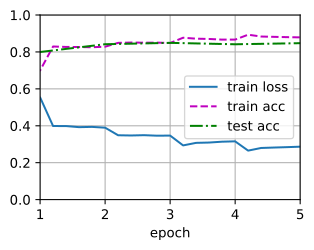
lr, num_epochs = 0.01, 5
net.compile(optimizer=keras.optimizers.Adam(lr),
            loss=keras.losses.SparseCategoricalCrossentropy(from_logits=True),
            metrics=['accuracy'])
net.fit(train_iter, validation_data=test_iter, epochs=num_epochs,
        verbose=2)
Epoch 1/5UserWarning: Your input ran out of data; interrupting training. Make sure that
your dataset or generator can generate at least `steps_per_epoch * epochs`
batches. You may need to use the `.repeat()` function when building your
dataset.391/391 - 61s - 156ms/step - accuracy: 0.7082 - loss: 0.5509 - val_accuracy: 0.8197 - val_loss: 0.4004
Epoch 2/5
391/391 - 48s - 124ms/step - accuracy: 0.8339 - loss: 0.3726 - val_accuracy: 0.8528 - val_loss: 0.3374
Epoch 3/5
391/391 - 46s - 117ms/step - accuracy: 0.8633 - loss: 0.3167 - val_accuracy: 0.8620 - val_loss: 0.3168
Epoch 4/5
391/391 - 47s - 120ms/step - accuracy: 0.8849 - loss: 0.2750 - val_accuracy: 0.8602 - val_loss: 0.3184
Epoch 5/5
391/391 - 45s - 115ms/step - accuracy: 0.8988 - loss: 0.2440 - val_accuracy: 0.8589 - val_loss: 0.3305<keras.src.callbacks.history.History at 0x788ccb2d2510>lr, num_epochs = 0.01, 4
optimizer = nnx.Optimizer(net, optax.adam(lr), wrt=nnx.Param)
loss_fn = optax.softmax_cross_entropy_with_integer_labels
@nnx.jit
def train_step(net, optimizer, X, y):
def compute_loss(model):
logits = model(X)
return loss_fn(logits, y).mean(), logits
(loss, logits), grads = nnx.value_and_grad(
compute_loss, has_aux=True)(net)
optimizer.update(net, grads)
return loss, logits
@nnx.jit
def eval_step(net, X):
return net(X)
for epoch in range(num_epochs):
loss_terms, train_correct_terms, num_train = [], [], 0
for X, y in train_iter:
l, logits = train_step(net, optimizer, X, y)
loss_terms.append(l * len(y))
train_correct_terms.append((logits.argmax(axis=-1) == y).sum())
num_train += len(y)
# Evaluate
correct_terms, total = [], 0
for X, y in test_iter:
logits = eval_step(net, X)
correct_terms.append((logits.argmax(axis=-1) == y).sum())
total += len(y)
loss_sum = float(jnp.stack(loss_terms).sum())
train_correct = int(jnp.stack(train_correct_terms).sum())
correct = int(jnp.stack(correct_terms).sum())
print(f'epoch {epoch + 1}, loss {loss_sum / num_train:.3f}, '
f'train acc {train_correct / num_train:.3f}, '
f'test acc {correct / total:.3f}')epoch 1, loss 0.627, train acc 0.632, test acc 0.796
epoch 2, loss 0.418, train acc 0.814, test acc 0.825
epoch 3, loss 0.364, train acc 0.844, test acc 0.847
epoch 4, loss 0.333, train acc 0.857, test acc 0.846# Adam's per-step update is ~lr * normalized_step, so unlike SGD it
# doesn't need a 1/batch_size rescale to match PyTorch's lr=0.01
# under d2l.train_batch_ch13's trainer.step(1).
lr, num_epochs = 0.01, 5
trainer = gluon.Trainer(net.collect_params(), 'adam', {'learning_rate': lr})
loss = gluon.loss.SoftmaxCrossEntropyLoss()
d2l.train_ch13(net, train_iter, test_iter, loss, trainer, num_epochs, devices)loss 0.349, train acc 0.845, test acc 0.812
535.7 examples/sec on [gpu(0)]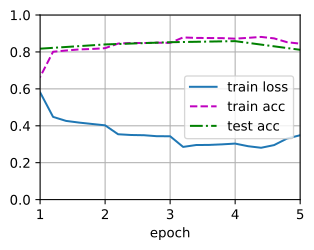
We define the following function to predict the sentiment of a text sequence using the trained model net.
def predict_sentiment(net, vocab, sequence):
    """Predict the sentiment of a text sequence."""
    sequence = torch.tensor(vocab[sequence.split()], device=d2l.try_gpu())
    label = torch.argmax(net(sequence.reshape(1, -1)), dim=1)
    return 'positive' if label == 1 else 'negative'
def predict_sentiment(net, vocab, sequence):
    """Predict the sentiment of a text sequence."""
    sequence = tf.constant(vocab[sequence.split()], dtype=tf.int32)
    sequence = tf.reshape(sequence, (1, -1))
    label = tf.argmax(net(sequence, training=False), axis=1)
    return 'positive' if int(label[0]) == 1 else 'negative'
def predict_sentiment(net, vocab, sequence):
    """Predict the sentiment of a text sequence."""
    sequence = jnp.array(vocab[sequence.split()])
    label = jnp.argmax(net(sequence.reshape(1, -1)), axis=1)
    return 'positive' if label == 1 else 'negative'
def predict_sentiment(net, vocab, sequence):
    """Predict the sentiment of a text sequence."""
    sequence = np.array(vocab[sequence.split()], ctx=d2l.try_gpu())
    label = np.argmax(net(sequence.reshape(1, -1)), axis=1)
    return 'positive' if label == 1 else 'negative'
Finally, let’s use the trained model to predict the sentiment for two simple sentences.
predict_sentiment(net, vocab, 'this movie is so great')'positive'predict_sentiment(net, vocab, 'this movie is so great')'positive'predict_sentiment(net, vocab, 'this movie is so great')'positive'predict_sentiment(net, vocab, 'this movie is so great')'positive'predict_sentiment(net, vocab, 'this movie is so bad')'negative'predict_sentiment(net, vocab, 'this movie is so bad')'negative'predict_sentiment(net, vocab, 'this movie is so bad')'negative'predict_sentiment(net, vocab, 'this movie is so bad')'positive'19.2.4 Summary
- Pretrained word vectors can represent individual tokens in a text sequence.
- Bidirectional RNNs can represent a text sequence, such as via the concatenation of its hidden states at the initial and final time steps. This single text representation can be transformed into categories using a fully connected layer.
19.2.5 Exercises
- Increase the number of epochs. Can you improve the training and testing accuracies? How about tuning other hyperparameters?
- Use larger pretrained word vectors, such as 300-dimensional GloVe embeddings. Does it improve classification accuracy?
- Can we improve the classification accuracy by using the spaCy tokenization? You need to install spaCy (
pip install spacy) and install the English package (python -m spacy download en_core_web_sm). In the code, first, import spaCy (import spacy). Then, load the spaCy English package (spacy_en = spacy.load('en_core_web_sm')). Finally, define the functiondef tokenizer(text): return [tok.text for tok in spacy_en.tokenizer(text)]and replace the originaltokenizerfunction. Note the different forms of phrase tokens in GloVe and spaCy. For example, the phrase token “new york” takes the form of “new-york” in GloVe and the form of “new york” after the spaCy tokenization.